




- 收藏
- 加入书签
高熵合金在核反应堆结构材料领域的研究进展
 打开文本图片集
摘要: 高熵合金被认为是潜在的核反应堆结构材料。本文重点阐述了高熵合金力学性能和耐辐照性能的研究成果,并分析了当前核反应堆用高熵合金在材料设计和模拟服役环境等方面的不足与今后的研究重点,以期为核反应堆结构材料的研究开发提供一定的方向。
关键词:高熵合金;力学性能;强化机制;耐辐照性能
一直以来,传统合金以一种或两种金属元素为主要组元,并将少量的一种或多种元素加入到主要组元中以提高力学、物理和化学性能是材料发展的主要思路,例如铁基合金、镍基合金、铝基合金、镁基合金等[1-3]。随着社会的发展,对合金性能提出了更高要求,而且过多类型微量元素的加入使合金中容易形成复杂的金属间化合物,导致合金性能的降低[4]。2004年,台湾学者叶均蔚教授和英国学者Cantor教授定义了一种全新的材料发展的思路,即多主元合金(又称高熵合金)[5, 6]。高熵合金是由四种及四种以上元素形成的随机固溶体合金,每种元素的含量在5% ~ 35%之间,元素之间没有溶剂溶质之分[5, 6]。由于多主元的特性,高熵合金展现出了一些相比于传统合金的独特性质,如高熵效应、晶格畸变效应、迟滞扩散效应和 “鸡尾酒”效应[7-9]。
近二十年来,科研工作者主要针对高熵合金材料的相结构、微结构、力学性能和耐辐照性能开展了大量的实验、模拟研究[10-13]。大多数高熵合金体系的相结构主要为面心立方(Face Centered Cubic, FCC)、体心立方结构(Body Centered Cubic, BCC)或两相共存结构,少数体系具有密排六方(Hexagonal close packed, HCP)结构[7, 14-16];高熵合金的相结构能在较高温度的条件下保持稳定[17]。高熵合金的微结构主要表现为以无序固溶体为基体,并包含纳米尺寸的化学有序结构[12, 14, 18];高熵合金的力学性能较传统合金更加优异,特别是其低温塑性和室温、高温强度;高熵合金的耐辐照性能相比于传统金属材料有极大的提高,其具体表现辐照肿胀、辐照脆化风险和辐照缺陷的保留率更低。高熵合金凭借其优异力学性能和耐辐照性能,而被认为是潜在的核反应堆结构材料[19-22]。
本文综述了近年来在高熵合金材料研究所取得的成果,重点从高熵合金力学性能和耐辐照性能等方面展开分析,并总结和展望了核反应堆用高熵合金的研究方向。
1 高熵合金的力学性能
1.1 单相高熵合金的力学性能
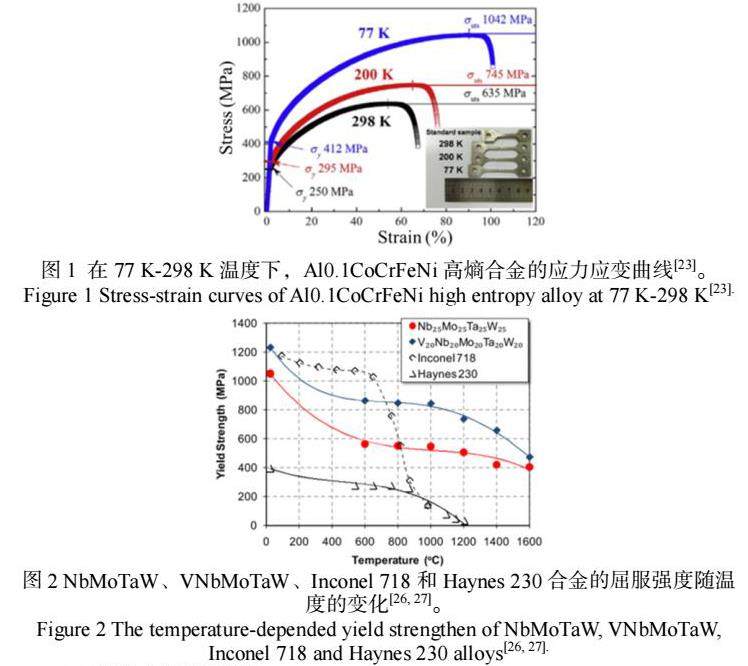
前期关于高熵合金力学性能的研究主要集中于单相高熵合金。FCC相高熵合金通常在低温至高温温度范围内具有优异的塑性,但其强度较低,特别是高温强度较低。Zhang等[23]制备了FCC相Al0.1CoCrFeNi高熵合金,并研究了它的低温和室温强度和塑性,结果表明该FCC相高熵合金在77 K的屈服强度和均匀伸长率分别为412 MPa和~ 80%,在298 K的屈服强度和均匀伸长率分别为250 MPa和~ 50%,如图1所示。Yang等[24]研究了Al0.1CoCrFeNi高熵合金的室温和高温力学性能,研究结果表明随温度升高,其屈服强度和拉伸强度逐渐降低;其断裂伸长率先增大后减小,在500 ℃时达到最大(33.73%);在700 ℃时其屈服强度和断裂伸长率分别降低至120 MPa和5.85%。相较于FCC相高熵合金,BCC相高熵合金具有较高的室温和高温强度,但其塑性较差。Joseph等[25]制备BCC相Al0.85CoCrFeNi高熵合金并研究了其室温力学性能。结果显示,该BCC相高熵合金具有较高的屈服强度(~ 1000 MPa)但其塑性极低(拉伸伸长率小于2%)。Pan和Senkov等[26, 27]研究了BCC结构VNbMoTaW高熵合金的力学性能,其室温屈服强度高达1058 MPa,但断裂伸长率仅有2.6%;当温度升高至1200 ℃时,其屈服强度仍高达735 MPa,相比于传统难熔合金表现出优异的抗高温软化能力,如图2所示。综上所述,单相高熵合金难以克服强度-塑性权衡(材料的强度提高伴随着塑性降低)的困境。
1.2 高熵合金的强韧化
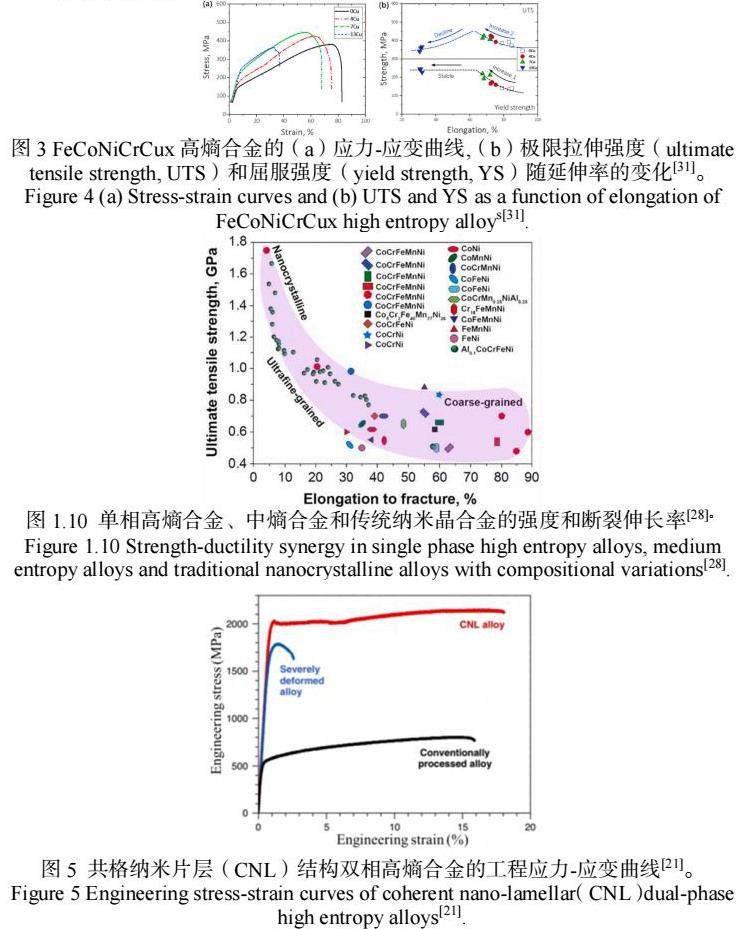
为实现高熵合金的强韧化,研究工作者的主要策略是通过固溶强化、细晶强化等提高FCC相高熵合金的强度,或通过软相(FCC相)和硬相(BCC相)结合的双相设计,使高熵合金同时具有高强度和高塑性[28, 29]。高熵合金中的固溶强化主要是源于溶质原子与滑移位错间的相互作用,固溶强化通常不会引起材料的塑性急剧降低,但对材料强度的提升幅度较小。例如,Wong等[30]通过向Al0.3CoCrFeNi高熵合金中添加Mn元素(6.5 at%)使合金结构发生严重的晶格畸变,将屈服强度由295 MPa提升至371 MPa,断裂伸长率从59%降低至46%。Du等[31]向FeCoNiCr高熵合金中添加Cu元素(4 at%)使得材料屈服强度从150 MPa提高至180 MPa,断裂伸长率由80%降低至75%,如图3所示。细晶强化是由晶粒细化后晶界增多引起的,因为在变形过程中晶界能有效地阻碍位错滑移。细晶强化能有效提高材料的室温强度和塑性,但在高温下晶粒长大会破坏原始的细晶结构,使得高温强度降低;高熵合金随晶粒尺寸的变化如图4所示。例如,Moazzen等[32]研究发现将Ni1.5FeCrCu0.5高熵合金的晶粒尺寸从700 nm降低至400 nm,其屈服强度从250 MPa增加到500 MPa,断裂伸长率从25%增加到36%。双相合金中硬相和软相的组合使其在平衡强度和塑性方面具有显著优势,同时在高温下其结构能长期保持稳定。目前,研究者已设计制备出多种双相高熵合金,大多具有超高的强度和可观的塑性。例如,Fan等[21]制备的纳米片层结构Ni32.8Fe21.9Co21.9Cr10.9Al7.5Ti5.0双相(FCC+L12)高熵合金具有优异的强度和塑性组合,力学性能测试表明其屈服强度高达2026 MPa,均匀伸长率达16%,如图5所示。纳米片层结构Ni30Co30Cr10Fe10Al18W2双相(FCC+BCC)高熵合金的断裂强度接近2000 MPa,均匀伸长率高达35%[33]。综上所述,双相高熵合金有利于克服强度-塑性权衡的困境。
过去两年的研究发现,双相高熵合金的超高强度-塑性源于塑性变形载体(位错、孪晶、相变带、堆积层错等)与异质界面的相互作用[34-39]。前期研究中,由于受到长时间和大尺寸的计算模拟精度不够、无法获得具有所需特征的界面(如连续、无元素偏析、界面类型可控)、以及传统的压缩或拉伸数据缺乏足够的信息等几个方面的限制,难以准确理解异质界面与力学性能的构效关系及作用机制[35, 37, 38, 40-43]。最近,Yang等[44]利用磁控溅射技术制备了具有共格和半共格异质界面的FCC/BCC Al-Cr-Fe-Ni双相高熵合金多层膜,利用纳米压入技术、透射电子显微镜和分子动力学模拟研究了其力学性能和塑性变行机制。研究结果表明,共格界面对位错滑移的阻碍较弱,使得材料的强度较低;半共格界面对位错滑移的阻碍较强,同时在变形过程中材料发生非晶化,使得材料具有较高的强度;此外,位错连续滑移延缓了局部应力集中,非晶化释放了变形过程中由于缺陷积累而形成的局部应力集中,从而延缓了裂纹的萌生。
2 高熵合金的耐辐照性能
目前,国内外研究者对高熵合金的耐辐照性能展开了广泛的研究,研究内容主要包括辐照缺陷的演化、辐照条件下相结构稳定性、辐照致偏析、辐照肿胀、辐照硬化脆化和耐辐照机理[22, 45-48]。
2.1 辐照缺陷演化
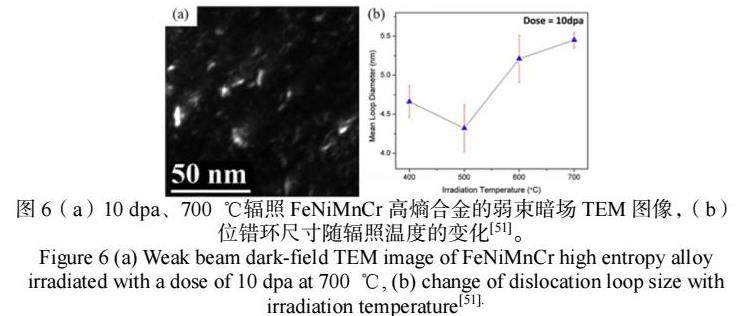
高熵合金在高能粒子辐照条件下会产生大量的点缺陷(空位和间隙原子),随着点缺陷的浓度升高,它们在材料中扩散聚集并形成不可见缺陷团簇或复合体;当点缺陷浓度继续升高到一定水平,会在材料中形成位错环、堆垛层错和孔洞等可见缺陷[48-50]。Kumar等[51]研究了FeNiMnCr高熵合金在3 MeV和5.8 MeV Ni+辐照下(辐照温度:室温至700 ℃;辐照剂量:0.03-10 dpa)辐照诱导缺陷的演化。结果表明,在所有温度下均观察到了高密度的位错环(1-10 nm);温度升高仅仅导致位错环平均尺寸略有增加,如图6所示;与传统的单相Fe-Cr-Ni奥氏体合金相比,该高熵合金具有更好的耐辐照性能。Lin等[47]利用分子动力学模拟的方法研究了NiCoCrFe高熵合金在辐照条件下辐照诱导缺陷的演化,并与纯金属Ni作对比。研究发现,在这两种材料中间隙团簇和空位团簇的大小或数量都随着初级撞出原子(Primary knock-on atom, PKA)能量的增加而增加,但在NiCoCrFe高熵合金中的增长速度较慢。高熵合金优异的耐辐照性能来源于高熵合金中原子级的化学无序。在电子层面上,化学无序状态往往会导致强烈的电子散射,从而显著降低电子的平均自由程,因此导致电子导率和热导率显著降低[13, 47]。在辐照条件下,低的电子导率和热导率使得高能离子轰击产生的缺陷能在较长时间内停留在局部,这有利于缺陷的重组[13, 47]。在原子层面上,化学无序使得缺陷的形成能和迁移能因局部原子环境不同而不同,因此,在高熵合金中空位和间隙原子的形成能和迁移能在分布范围上十分宽泛。与纯金属材料相比,高熵合金中缺陷的迁移会经历更加剧烈的能量起伏,这有利于局部低能位点将缺陷困在其中,并改变了缺陷的扩散路径和扩散机制[13, 47]。
2.2 辐照致偏析
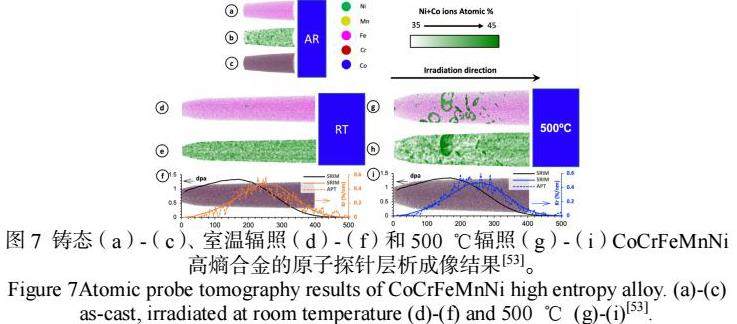
辐照致偏析是指在辐照条件下,材料中的原子或缺陷发生迁移,导致元素浓度的不均匀分布的现象。Chen等[52]研究了CrFeMnNi和AlCrFeMnNi高熵合金在5 MeV Fe2+辐照条件下(辐照温度:500 ℃;辐照剂量:50 dpa和100 dpa)的元素分布和相结构演变。结果显示,辐照前后高熵合金中的相组成一致,此外未观察到辐照导致的元素偏析,这表明高熵合金具有优异的相结构稳定性。Chen等[53]研究了CoCrFeMnNi高熵合金在1 MeV Kr+辐照条件下(辐照温度:室温和500 ℃;辐照注量:6.3 × 10¹⁸ ions/m2)的元素分布变化。结果显示,室温辐照条件下,高熵合金无元素偏析现象;但在500 ℃辐照条件下,Co和Ni在位错环周围偏析,如图7所示。Sun等[45]研究了在80 eV He+辐照条件下(辐照温度:室温;辐照注量:6 × 10¹⁸ ~ 1.8 × 10²¹ ions/cm2)BCC结构Al1.5CrFeNi高熵合金的元素偏析行为和相结构演变。研究发现,在6 × 1018 ions/cm2的辐照注量下,高熵合金中未发生元素偏析;但当辐照注量升高至1.8 × 1021 ions/cm2后,高熵合金中Cr元素发生严重偏析,其相结构由单一BCC变为FCC+BCC+BCC1。这些实验结果表明,高熵合金在辐照条件下的相结构稳定性和元素偏析行为与高熵合金体系和辐照条件密切相关。
2.3 辐照肿胀
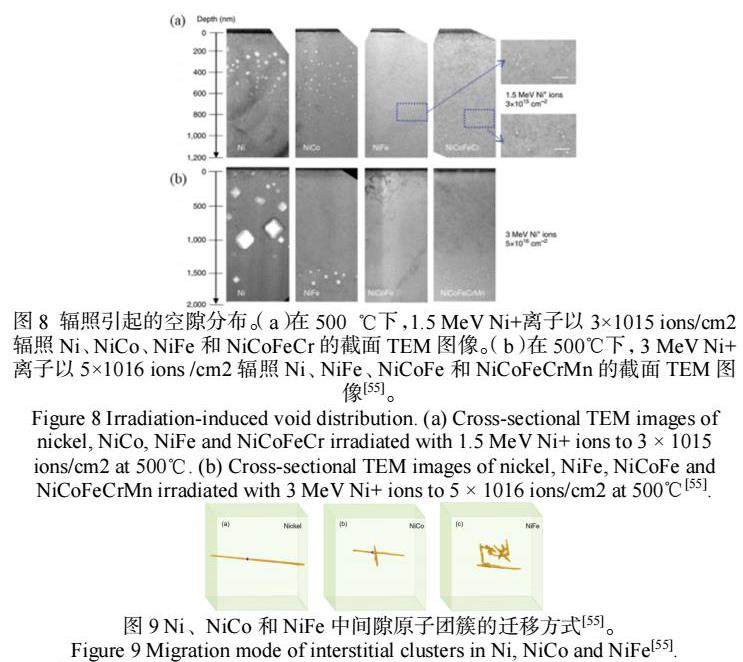
辐照肿胀是指在辐照下材料中空位和嬗变产物He达到一定浓度之后聚集形成三维晶体缺陷孔洞和气泡引起的材料密度降低和体积膨胀。Xia等[54]研究了AlxCoCrFeNi高熵合金在3 MeV能量Au+辐照下的耐辐照性能,发现室温下Al0.1CoCrFeNi经历65 dpa高损伤后,辐照肿胀率仅为1.25%,相对于奥氏体不锈钢(Fe-15Cr-20Ni)在60 dpa的30%肿胀率以及M316不锈钢在30 dpa的近20%肿胀率,高熵合金在高辐照损伤下表现出了极高的结构稳定性。Lu等[55, 56]研究了1.5 MeV 和3 MeV Ni+(辐照温度:500 ℃;辐照注量:5 × 10¹⁵ ions/cm2和5 × 1016 ions/cm2)辐照条件下Ni、NiCo、NiFe、NiCoFe、NiCoFeCr 和 NiCoFeCrMn的辐照肿胀。实验结果显示,这六种材料的辐照肿胀率由大到小依次为Ni > NiCo > NiFe > NiCo > FeCr > NiCoFer > NiCoFeCrMn,表明高熵合金相比于纯金属、二元和三元合金具有更好的抗辐照肿胀性能,如图8所示。分子动力学模拟结果表明,高熵合金抗辐照肿胀能力的增强是由合金中的间隙缺陷簇由长程一维扩散向短程三维扩散转变增强点缺陷重组导致的,如图9所示。Yang等[57]研究表明NiCoFeCrMn的抗辐照肿胀能力与辐照温度相关;随温度升高,抗辐照肿胀能力先减弱后增强,在580 ℃时最弱,但辐照肿胀率仍小于0.5%;这是由于高熵合金中饱和空位浓度增加使得辐照肿胀率难以随温度而增大。
2.4 辐照硬化
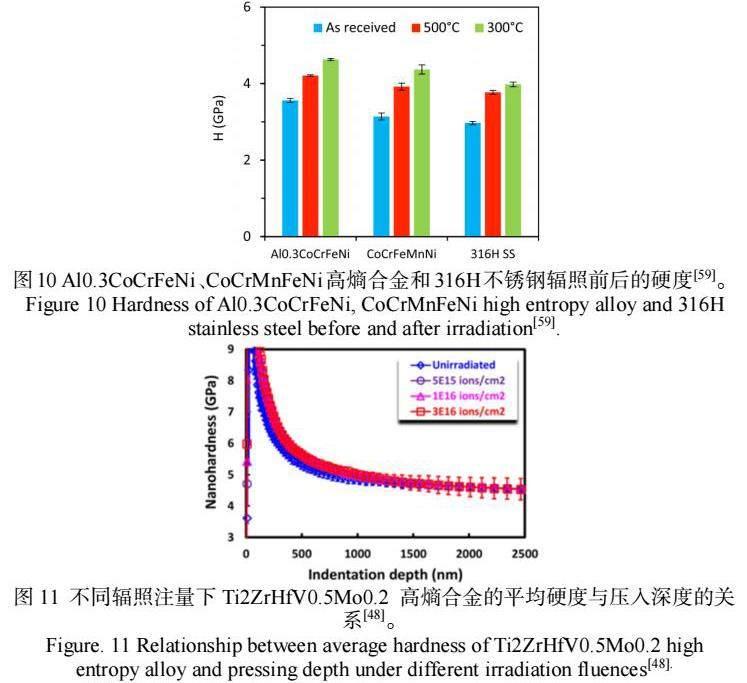
辐照硬化是由在辐照下材料中形成的各种缺陷(如缺陷团簇、位错环、孔洞和气泡以及析出相等)强烈地阻碍位错运动引起的。Chen等[58, 59]研究了Al0.3CoCrFeNi、CoCrMnFeNi高熵合金和316H不锈钢在1 MeV Kr+(辐照温度:300 ℃和500 ℃;辐照剂量:1 dpa)辐照条件下的缺陷特征和硬度变化。结果显示,在300 ℃辐照条件下这三种材料中的位错环尺寸和密度相当,辐照硬化程度相似(ΔH= ~1 GPa);但在500 ℃辐照条件下,相比于316H不锈钢,Al0.3CoCrFeNi、CoCrMnFeNi高熵合金中位错环的尺寸较大但密度较小, Al0.3CoCrFeNi的辐照硬化程度最小(ΔH= ~ 0.65 GPa),CoCrMnFeNi的辐照硬化程度居中(ΔH= ~ 0.8 GPa),316H不锈钢的辐照硬化程度最大(ΔH= ~ 0.85 GPa),如图10所示。Lu等[48]研究了在3 MeV He+(辐照温度:600 ℃;辐照注量:5 × 10¹⁵-3 × 10¹⁶ ions/cm2)辐照条件下Ti2ZrHfV0.5Mo0.2高熵合金的力学性能,发现辐照后没有明显的硬化现象,如图11所示。这些结果表明,在低温辐照条件下,成分变化和高构型熵对辐照高熵合金的力学性能的影响很小,高熵合金的抗辐照硬化能力与传统合金相当;但在高温辐照条件下,高熵合金比传统合金更抗辐照硬化。
3 总结与展望
相比于传统合金,高熵合金凭借优异的力学性能和耐辐照性能,在核反应堆结构材料领域具有巨大的应用前景。其中,双相高熵合金通过软硬双相匹配及异质界面与塑性载体相互作用而在室温到高温范围内具有强韧化特性;再加上异质界面可通过管理辐照点缺陷(吸收、湮灭、发射和重组等)而提升材料耐辐照性能;因此,双相高熵合金可能是未来先进核反应堆结构材料的理想材料。但目前针对核反应堆用高熵合金材料的研究较为分散、不够系统,材料性能、结构等相关数据有限,多数实验无法精确模拟核反应堆服役环境。针对此类问题,今后仍需加强以下几个方面的研究:
1.目前研究的双相高熵合金的体系较少,还需综合元素选择和成分设计方法,开发出适用于特定核反应堆环境的双相高熵合金。
2.鉴于异质界面在双相高熵合金力学性能和耐辐照性能中的重要作用,仍需探索块体双相高熵合金的界面结构控制方法和工艺,并深入开展具有不同界面结构的块体双相高熵合金的力学性能和耐辐照性能的研究,为双相高熵合金的工程应用提供数据支持和奠定理论基础。
3.单一的力学和辐照实验并不能准确评价材料的综合性能,因此展开材料在高温、外加应力和辐照等多场耦合下的性能研究将非常有必要。
参考文献
[1] Kong H J, Yang T, Chen R, et al. Design of ultra-strong but ductile iron-based alloys with low supersaturations [J]. Acta Materialia, 2023, 256: 119000.
[2] Pan Z, Luo H, Zhao Q, et al. Effect of Hf addition on microstructural evolution and corrosion behavior of nickel-based alloys in hydrochloric acid [J]. Corrosion Science, 2023, 224: 111507.
[3] Deng P, Mo W, Ouyang Z, et al. Microstructural evolution and corrosion mechanism of micro-alloyed 2024 (Zr, Sc, Ag) aluminum alloys [J]. Corrosion Science, 2023, 224: 111476.
[4] Yeh J-W. Overview of High-Entropy Alloys [M]//GAO M C, YEH J-W, LIAW P K, et al. High-Entropy Alloys: Fundamentals and Applications. Cham; Springer International Publishing. 2016: 1-19.
[5] Yeh J W, Chen S K, Lin S J, et al. Nanostructured High-Entropy Alloys with Multiple Principal Elements: Novel Alloy Design Concepts and Outcomes [J]. Advanced Engineering Materials, 2004, 6(5): 299-303.
[6] Cantor B, Chang I T H, Knight P, et al. Microstructural development in equiatomic multicomponent alloys [J]. Materials Science and Engineering: A, 2004, 375-377: 213-8.
[7] Yeh J-W. Physical Metallurgy [M]//GAO M C, YEH J-W, LIAW P K, et al. High-Entropy Alloys: Fundamentals and Applications. Cham; Springer International Publishing. 2016: 51-113.
[8] Dąbrowa J, Zajusz M, Kucza W, et al. Demystifying the sluggish diffusion effect in high entropy alloys [J]. Journal of Alloys and Compounds, 2019, 783: 193-207.
[9] Jiang J, Sun W, Luo N. Atomic insights into effects of temperature and grain diameter on the micro-deformation mechanism, mechanical properties and sluggish diffusion of nanocrystalline high-entropy alloys [J]. Materials Today Communications, 2022, 33: 104224.
[10] Zhong X, Zhang Q, Xie J, et al. Mechanical properties and microstructure of the Al0.3CoCrFeNiTi0.3 high entropy alloy under dynamic compression [J]. Materials Science and Engineering: A, 2021, 812:
[11] Bhattacharjee P P, Sathiaraj G D, Zaid M, et al. Microstructure and texture evolution during annealing of equiatomic CoCrFeMnNi high-entropy alloy [J]. Journal of Alloys and Compounds, 2014, 587: 544-52.
[12] Fernández-Caballero A, Wróbel J S, Mummery P M, et al. Short-Range Order in High Entropy Alloys: Theoretical Formulation and Application to Mo-Nb-Ta-V-W System [J]. Journal of Phase Equilibria and Diffusion, 2017, 38(4): 391-403.
[13] Zhao S, Zhang Y, Weber W J. High Entropy Alloys: Irradiation [M]. Reference Module in Materials Science and Materials Engineering. 2020.
[14] George E P, Raabe D, Ritchie R O. High-entropy alloys [J]. Nature Reviews Materials, 2019, 4(8): 515-34.
[15] Jin X, Liang Y, Bi J, et al. Enhanced strength and ductility of Al0.9CoCrNi2.1 eutectic high entropy alloy by thermomechanical processing [J]. Materialia, 2020, 10: 100639.
[16] Yan X H, Li J S, Zhang W R, et al. A brief review of high-entropy films [J]. Materials Chemistry and Physics, 2018, 210: 12-9.
[17] Tian Y-s, Zhou W-z, Tan Q-b, et al. A review of refractory high-entropy alloys [J]. Transactions of Nonferrous Metals Society of China, 2022, 32(11): 3487-515.
[18] Wu Y, Zhang F, Yuan X, et al. Short-range ordering and its effects on mechanical properties of high-entropy alloys [J]. Journal of Materials Science & Technology, 2021, 62: 214-20.
[19] Shi P, Ren W, Zheng T, et al. Enhanced strength-ductility synergy in ultrafine-grained eutectic high-entropy alloys by inheriting microstructural lamellae [J]. Nature communications, 2019, 10(1): 489.
[20] Xiong T, Zheng S, Pang J, et al. High-strength and high-ductility AlCoCrFeNi2.1 eutectic high-entropy alloy achieved via precipitation strengthening in a heterogeneous structure [J]. Scripta Materialia, 2020, 186: 336-40.
[21] Fan L, Yang T, Zhao Y, et al. Ultrahigh strength and ductility in newly developed materials with coherent nanolamellar architectures [J]. Nature communications, 2020, 11(1): 6240.
[22] Yang Z, Qiu N, Yang H, et al. Irradiation tolerance enhanced by coherent interfaces of FCC/BCC HEA multilayers [J]. Surface and Coatings Technology, 2023, 457:
[23] Li D, Zhang Y. The ultrahigh charpy impact toughness of forged AlxCoCrFeNi high entropy alloys at room and cryogenic temperatures [J]. Intermetallics, 2016, 70: 24-8.
[24] Yang T, Tang Z, Xie X, et al. Deformation mechanisms of Al0.1CoCrFeNi at elevated temperatures [J]. Materials Science and Engineering: A, 2017, 684: 552-8.
[25] Joseph J, Stanford N, Hodgson P, et al. Understanding the mechanical behaviour and the large strength/ductility differences between FCC and BCC AlxCoCrFeNi high entropy alloys [J]. Journal of Alloys and Compounds, 2017, 726: 885-95.
[26] Pan J, Dai T, Lu T, et al. Microstructure and mechanical properties of Nb25Mo25Ta25W25 and Ti8Nb23Mo23Ta23W23 high entropy alloys prepared by mechanical alloying and spark plasma sintering [J]. Materials Science and Engineering: A, 2018, 738: 362-6.
[27] Senkov O N, Wilks G B, Scott J M, et al. Mechanical properties of Nb25Mo25Ta25W25 and V20Nb20Mo20Ta20W20 refractory high entropy alloys [J]. Intermetallics, 2011, 19(5): 698-706.
[28] Ali N, Zhang L, Liu D, et al. Strengthening mechanisms in high entropy alloys: A review [J]. Materials Today Communications, 2022, 33: 104686.
[29] Chung S, Lee B, Lee S Y, et al. The effects of Y pre-alloying on the in-situ dispersoids of ODS CoCrFeMnNi high-entropy alloy [J]. Journal of Materials Science & Technology, 2021, 85: 62-75.
[30] Wong S-K, Shun T-T, Chang C-H, et al. Microstructures and properties of Al0.3CoCrFeNiMnx high-entropy alloys [J]. Materials Chemistry and Physics, 2018, 210: 146-51.
[31] Du C, Hu L, Pan Q, et al. Effect of Cu on the strengthening and embrittling of an FeCoNiCr-xCu HEA [J]. Materials Science and Engineering: A, 2022, 832: 142413.
[32] Moazzen P, Toroghinejad M R. Enhancement of mechanical properties of a novel single phase Ni1.5FeCrCu0.5 HEA through cold rolling and subsequent annealing [J]. Materials Science and Engineering: A, 2022, 848: 143360.
[33] Wu Q, He F, Li J, et al. Phase-selective recrystallization makes eutectic high-entropy alloys ultra-ductile [J]. Nature communications, 2022, 13(1): 4697.
[34] Wang Y, Chen W, Zhang J, et al. A quantitative understanding on the mechanical behavior of AlCoCrFeNi2.1 eutectic high-entropy alloy [J]. J Alloys Compd, 2021, 850: 156610.
[35] Fan L, Yang T, Zhao Y, et al. Ultrahigh strength and ductility in newly developed materials with coherent nanolamellar architectures [J]. Nat Commun, 2020, 11(1): 6240.
[36] Xiong T, Yang W, Zheng S, et al. Faceted Kurdjumov-Sachs interface-induced slip continuity in the eutectic high-entropy alloy, AlCoCrFeNi2.1 [J]. J Mater Sci Technol, 2021, 65: 216–27.
[37] Shi P, Li R, Li Y, et al. Hierarchical crack buffering triples ductility in eutectic herringbone high-entropy alloys [J]. Science, 2021, 373(6557): 912–8.
[38] Kim J, Hong S J, Lee J K, et al. Development of coherent-precipitate-hardened high-entropy alloys with hierarchical NiAl/Ni2TiAl precipitates in CrMnFeCoNiAlxTiy alloys [J]. Mater Sci Eng A, 2021, 823: 141763.
[39] Zhong X, Zhang Q, Ma M, et al. Dynamic compressive properties and microstructural evolution of Al1.19Co2CrFeNi1.81 eutectic high entropy alloy at room and cryogenic temperatures [J]. Materials & Design, 2022, 219: 110724.
[40] Ma Y, Hao J, Jie J, et al. Coherent precipitation and strengthening in a dual-phase AlNi2Co2Fe1.5Cr1.5 high-entropy alloy [J]. Mater Sci Eng A, 2019, 764: 138241.
[41] Wang J, Zhou Q, Shao S, et al. Strength and plasticity of nanolaminated materials [J]. Mater Res Lett, 2016, 5(1): 1–19.
[42] Cao Z H, Zhai G Y, Ma Y J, et al. Evolution of interfacial character and its influence on strain hardening in dual-phase high entropy alloys at nanoscale [J]. International Journal of Plasticity, 2021, 145: 103081.
[43] Fu Z, Jiang L, Wardini J L, et al. A high-entropy alloy with hierarchical nanoprecipitates and ultrahigh strength [J]. Sci Adv, 2018, 4(10): eaat8712.
[44] Yang Z, Fu B, Ning Z, et al. Amorphization activated by semicoherent interfaces of FCC/BCC HEA multilayers during deformation [J]. Materials & Design, 2023, 225: 111469.
[45] Sun S, Qiu N, Zhang K, et al. Segregation of Al1.5CrFeNi high entropy alloys induced by vacancy-type defects [J]. Scripta Materialia, 2019, 161: 40-3.
[46] Pu G, Lin L, Ang R, et al. Outstanding radiation tolerance and mechanical behavior in ultra-fine nanocrystalline Al1.5CoCrFeNi high entropy alloy films under He ion irradiation [J]. Applied Surface Science, 2020, 516:
[47] Lin Y, Yang T, Lang L, et al. Enhanced radiation tolerance of the Ni-Co-Cr-Fe high-entropy alloy as revealed from primary damage [J]. Acta Materialia, 2020, 196: 133-43.
[48] Lu Y, Huang H, Gao X, et al. A promising new class of irradiation tolerant materials: Ti2ZrHfV0.5Mo0.2 high-entropy alloy [J]. Journal of Materials Science & Technology, 2019, 35(3): 369-73.
[49] Zheng R-Y, Han W-Z. Comparative study of radiation defects in ion irradiated bulk and thin-foil tungsten [J]. Acta Materialia, 2020, 186: 162-71.
[50] Zhu H, Qin M, Aughterson R, et al. The formation and accumulation of radiation-induced defects and the role of lamellar interfaces in radiation damage of titanium aluminum alloy irradiated with Kr-ions at room temperature [J]. Acta Materialia, 2020, 195: 654-67.
[51] Kumar N A P K, Li C, Leonard K J, et al. Microstructural stability and mechanical behavior of FeNiMnCr high entropy alloy under ion irradiation [J]. Acta Materialia, 2016, 113: 230-44.
[52] Chen Y, Chen D, Weaver J, et al. Heavy ion irradiation effects on CrFeMnNi and AlCrFeMnNi high entropy alloys [J]. Journal of Nuclear Materials, 2023, 574: 154163.
[53] Chen W-Y, Poplawsky J D, Chen Y, et al. Irradiation-induced segregation at dislocation loops in CoCrFeMnNi high entropy alloy [J]. Materialia, 2020, 14: 100951.
[54] Xia S Q, Yang X, Yang T F, et al. Irradiation Resistance in AlxCoCrFeNi High Entropy Alloys [J]. Journal of the Minerals, Metals Materials Society, 2015, 67(10): 2340-4.
[55] Lu C, Niu L, Chen N, et al. Enhancing radiation tolerance by controlling defect mobility and migration pathways in multicomponent single-phase alloys [J]. Nature communications, 2016, 7(1): 13564.
[56] Jin K, Lu C, Wang L M, et al. Effects of compositional complexity on the ion-irradiation induced swelling and hardening in Ni-containing equiatomic alloys [J]. Scripta Materialia, 2016, 119: 65-70.
[57] Yang T-n, Lu C, Velisa G, et al. Influence of irradiation temperature on void swelling in NiCoFeCrMn and NiCoFeCrPd [J]. Scripta Materialia, 2019, 158: 57-61.
[58] Chen W-Y, Liu X, Chen Y, et al. Irradiation effects in high entropy alloys and 316H stainless steel at 300 °C [J]. Journal of Nuclear Materials, 2018, 510: 421-30.
[59] Chen W-Y, Kirk M A, Hashimoto N, et al. Irradiation effects on Al0.3CoCrFeNi and CoCrMnFeNi high-entropy alloys, and 316H stainless steel at 500 °C [J]. Journal of Nuclear Materials, 2020, 539: 152324.

 京公网安备 11011302003690号